Introduction
ATSScores is an AI resume keyword checker and resume tailoring tool built around a practical job-search problem: adapting one resume to many job descriptions without doing a full rewrite each time. The public page presents the product as a way to find missing ATS keywords, receive precise bullet-level suggestions, and tailor a resume faster than a generic AI rewrite workflow.
The clearest audience is job seekers who already have a resume and want a more structured way to match it to each role. The tool appears useful for speeding up resume review, but users should still treat every suggestion as something to verify against their actual work history.
Key Features
- Resume-to-job-description comparison for identifying missing ATS keywords.
- Job-specific suggestions for resume keywords, bullet points, and related sections.
- Precise edit guidance intended to avoid long full-document rewrites.
- Resume scanning that analyzes structure, bullet points, headers, and formatting.
- Support signals for PDF, Word, and Google Docs resume formats.
- Site-described future workflow features such as a Chrome extension for LinkedIn job pages, one-click edits, and instant PDF download.
Use Cases
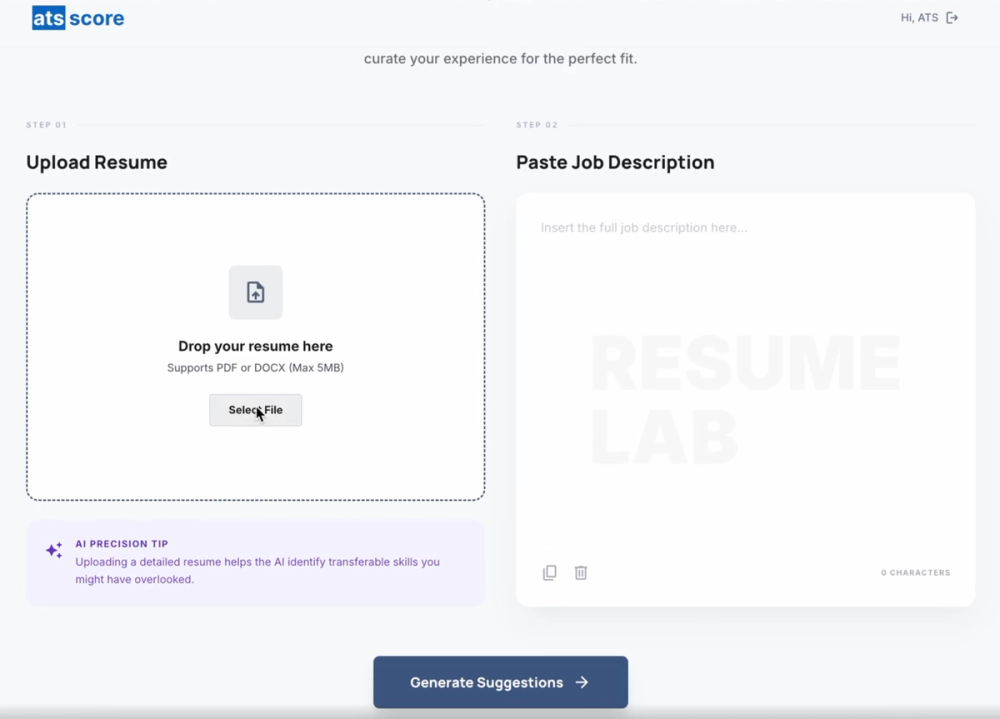
ATSScores fits candidates who are applying to multiple jobs and need to adjust a resume for each posting. The site describes a workflow where users upload a resume once, paste a job description, and receive tailored suggestions rather than starting from scratch for every application.
It may also be useful when a candidate wants to avoid generic resume prompts. The public page argues that broad ChatGPT rewrites can create a new version of the same resume that still requires manual comparison. ATSScores instead focuses on narrower improvements: missing keywords, specific bullet changes, and resume gaps tied to the target role.
A cautious use case is preparing for applicant tracking systems without over-optimizing. Keyword matching can help a resume reflect relevant experience more clearly, but the candidate should only apply suggestions that are accurate, defensible, and consistent with what they can discuss in an interview.
Pricing
The page describes ATSScores as a free AI resume keywords checker and mentions "Free 1 month" access for early adopters. A full pricing table, renewal cost, usage caps, paid plan differences, and refund details are not visible in the fetched page content. Anyone planning to use the tool throughout a job search should confirm current pricing and access limits before relying on it.
User Experience and Support
The public page emphasizes a simple sequence: upload a resume, paste a job description, review missing keywords and bullet suggestions, then apply relevant edits. The demo copy includes an ATS match score and examples such as React, Figma, UX Research, Agile, and Design Systems, which helps explain the intended resume-optimization workflow.
Support signals are thinner than the product workflow signals. The page includes guide-style language about using AI to optimize a resume with job-description keywords, but it does not clearly show a support email, help center, live chat, or documentation library in the fetched evidence. Users who expect troubleshooting, account help, or human resume advice should verify support options before depending on the product.
Technical Details
ATSScores is presented as an AI-assisted resume tailoring product that scans a resume's structure and compares it with a job description. The site says it works with PDF, Word, and Google Docs, and it describes analysis of bullet points, headers, and formatting.
The page also mentions a Chrome extension for tailoring directly on LinkedIn job pages, one-click edits, and instant PDF export as future-facing functionality. It does not provide detailed information about model providers, API access, browser-extension release status, account requirements, or full data-retention terms beyond the page's statement that files are not stored or shared. Users with sensitive documents should review current privacy and product terms before uploading.
Pros and Cons
Pros
- Focuses on targeted resume edits instead of rewriting the whole resume.
- Connects suggestions to a specific job description.
- Addresses a real repeated task for active job seekers.
- Mentions compatibility with common resume formats.
- Provides a clear public demo concept for keyword gaps and bullet improvements.
Cons
- Complete long-term pricing details are not visible in the fetched content.
- Support and documentation channels are not clearly surfaced.
- Some LinkedIn and export workflow features appear to be upcoming rather than confirmed as fully available.
- Users must still check that suggested skills and keywords reflect their actual experience.
- ATS scoring examples should be read as product demonstration, not as a hiring prediction.
FAQ
What is ATSScores?
ATSScores is an AI resume keyword checker and resume tailoring tool. It helps users compare a resume with a job description, find missing ATS keywords, and review targeted suggestions for improving resume relevance.
Who is ATSScores best for?
It appears best for job seekers applying to multiple roles who want a repeatable way to tailor an existing resume. It is especially relevant when job descriptions vary by tools, responsibilities, and role-specific terminology.
Does ATSScores rewrite the whole resume?
The public page positions the tool as an alternative to full generic rewrites. Its emphasis is on specific keyword gaps and bullet-level improvements rather than replacing the user's entire resume narrative.
What file formats are mentioned by ATSScores?
The site mentions PDF, Word, and Google Docs formats. Users should still review the final resume after edits to ensure formatting remains clean and applicant-ready.
How much does ATSScores cost?
The fetched page calls it a free AI resume keywords checker and mentions a free month for early adopters. It does not show full long-term pricing details, so users should verify current plan terms before committing to repeated use.
What privacy details are visible?
The public page says user data stays private and that files are not stored or shared. Because resumes can include sensitive personal information, users should still check the latest privacy terms before uploading documents.
Is the LinkedIn Chrome extension available now?
The page mentions a Chrome extension for tailoring directly on LinkedIn job pages as part of the product direction. Readers should confirm whether it is currently available, limited to early access, or still planned.
What should users watch out for when using resume keyword suggestions?
Users should avoid adding keywords that do not match their real background. The safest use of ATSScores is to clarify relevant experience already present in the resume, not to create claims the candidate cannot support.
Conclusion
ATSScores presents a focused resume-tailoring workflow for job seekers who want to move beyond generic AI rewrites. Its visible strengths are keyword-gap detection, specific edit suggestions, and a workflow aimed at repeated job applications.
The product is most useful when paired with careful human judgment. Before relying on it heavily, users should verify pricing, support options, privacy terms, and the availability of any LinkedIn or Chrome-extension features they expect to use.