Introduction
Rate My Professor is a student-powered professor ratings and course review platform. The public page says it helps students read honest ratings, compare teaching styles, and choose professors who match how they learn before enrolling in a class.
The clearest audience is students making course decisions and students who want to leave anonymous, constructive feedback after taking a class. The site also positions professor reviews as a way to make teaching quality and classroom experience more transparent, although readers should treat individual ratings as peer feedback rather than formal academic assessment.
Key Features
- Professor search: The site includes a search path for finding professors and reviewing available feedback.
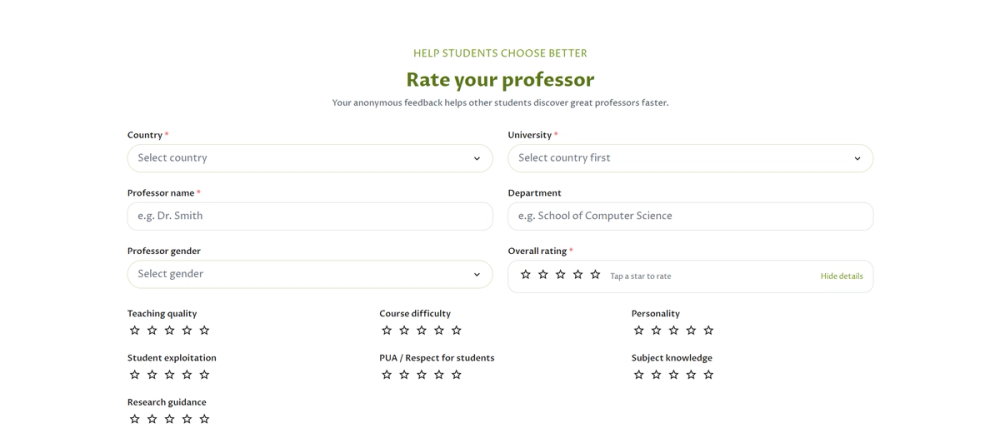
- Student ratings: Users can rate professors through a form that includes overall rating and more detailed fields.
- Anonymous feedback: The public copy says anonymous feedback helps other students discover professors faster.
- Course and teaching criteria: The rating form includes fields such as teaching quality, course difficulty, personality, respect for students, subject knowledge, research guidance, and comments.
- Country and university selection: The review form asks users to choose a country and university before submitting professor feedback.
- Community sections: The navigation includes Countries, Forum, and Suggest a University, suggesting the platform is built around student participation and regional expansion.
Use Cases
Rate My Professor is most useful when a student is choosing between instructors for an upcoming course. Instead of relying only on course titles or schedules, students can look for patterns in peer comments about teaching style, difficulty, support, subject knowledge, and classroom fit.
The platform also gives students a place to share post-course feedback. The public review form asks users to avoid personal information and keep feedback respectful and constructive, which is important for making reviews more useful to other students.
Universities and academic communities may also find value in broad review patterns, though the site should not be treated as a formal evaluation system. Student reviews can highlight experiences and concerns, but individual comments may be subjective, incomplete, or influenced by course context.
Pricing
Pricing details are not clearly visible on the fetched public page. Rate My Professor appears accessible for core actions such as searching, browsing countries, visiting forums, suggesting a university, and submitting a review without an account, but the page does not show paid plans, subscriptions, advertising products, or premium features. Users should check the official site if they need current information about any future monetization or account requirements.
User Experience and Support
The public page presents a straightforward student workflow: search professors, browse countries, visit forums, suggest a university, or rate a professor. The review form is detailed enough to capture more than a simple star rating, with fields for professor name, department, gender, overall rating, detailed teaching factors, courses, recommendation, comments, and a self-verification prompt.
Support appears community- and guidance-oriented rather than help-desk driven. The site provides review instructions such as avoiding personal information and keeping feedback respectful and constructive, and it includes links for About Us, Suggest University, Terms of Service, and Privacy Policy. Students submitting reviews should read those policies before posting, especially when discussing sensitive classroom experiences.
Technical Details
Rate My Professor is a web-based platform focused on searchable professor ratings and student review submission. The visible review flow includes country and university selectors, a star-based overall rating, optional detail fields, comment input, and a verification-code step before submission.
The page also states that reviews are stored securely and that no account is required. It does not show a public API, data export tools, institutional integrations, or moderation workflow details. For schools, researchers, or student groups that need structured data access or governance information, those details should be verified directly.
Pros and Cons
Pros
- Focused purpose: professor ratings and course reviews are central to the site.
- Review form captures multiple dimensions of the classroom experience.
- Anonymous feedback can make students more comfortable sharing course impressions.
- No account required is visible in the review flow.
- Country, university, forum, and suggest-university navigation supports broader student participation.
Cons
- Pricing or monetization details are not visible in the fetched page.
- Reviews are subjective and should not be treated as verified academic records.
- Moderation, dispute, and professor response processes are not clearly explained in the available evidence.
- Some placeholder text appears on the page, which may reduce confidence in the site's editorial polish.
- Students should be careful not to include personal information or defamatory comments in reviews.
FAQ
What is Rate My Professor?
Rate My Professor is a student-powered platform for professor ratings and course reviews. It helps students read peer feedback, compare teaching styles, and choose professors who may better match their learning preferences.
Who should use Rate My Professor?
Students choosing courses are the clearest users. The site is also relevant for students who want to share constructive feedback about a professor and for academic communities interested in understanding student experiences.
What information can students include in a professor review?
The visible review form includes country, university, professor name, department, professor gender, overall rating, teaching quality, course difficulty, personality, respect for students, subject knowledge, research guidance, courses, recommendation, and comments.
Does Rate My Professor require an account?
The page says reviews are stored securely and no account is required. Users should still review the latest terms and privacy policy before submitting feedback.
How reliable are professor ratings on the site?
The ratings are student feedback, so they can be useful for spotting patterns but should not be treated as a complete or official measure of teaching quality. Students should compare multiple reviews and consider course requirements, instructor style, and their own learning needs.
What should students avoid when writing a review?
The site asks users to avoid sharing personal information and to keep feedback respectful and constructive. A good review should focus on observable teaching experience, course structure, communication, and learning support rather than personal attacks.
Does Rate My Professor show pricing or paid features?
The fetched page does not clearly show pricing or paid features. The visible experience focuses on searching professors, browsing countries, forums, suggesting universities, and submitting reviews.
Conclusion
Rate My Professor gives students a public place to compare professor feedback and contribute their own classroom experiences. Its strongest visible elements are the student-powered positioning, detailed review form, anonymous feedback language, and course-decision focus.
The platform is most useful when reviews are read carefully and in context. Students should look for patterns across feedback, avoid overreacting to a single review, and use the official Rate My Professor site policies to understand how their own comments should be submitted.